


–
The coffee was under-rated. Not in that tragic way, but in that specific hotel boardroom way, thick with ambition and that familiar hotel blend that forgets that its meant to be coffee. Outside, Cape Town was doing its thing, clusters of office workers gathered on pavements for smoke breaks, while the wind flirted with indecision, unsure whether to keep it to a soft tango or escalate into a full-blown foxtrot. I was hunched over a notepad, half-listening, half-panicking, surrounded by my COFEM colleagues.
It was a day before the SVRI Forum 2024 was scheduled to begin and we were in a planning session, huddled around a long table in a room that looked more finance retreat than feminist strategy session. Outside, the city’s pulse hummed, taxis weaving, voices rising, the usual city noise while our signature mountain watched over it all like an old friend who’s seen too much and still shows up. Inside, we were trying to figure out how to distil a movement into a plan.
We were reminded that resistance doesn’t always roar, sometimes it gathers quietly, around a table, in the shape of a question, a joke, a spark. This is the magic sauce: connection that restores, renews, and reminds us who we are when the world keeps asking us to forget.”
Where people show up as they are
There was a subtle weight in my chest, the kind that settles in when doubt arrives unannounced. I love COFEM (Coalition of Feminists for Social Change). I believe in it with everything I have. But in that moment, in that stuffy Cape Town boardroom, I felt a flicker of panic. What if we didn’t have a magic sauce? What if the thing I thought was luminous was just familiar? The Forum hadn’t even started, and already I was spiralling. We were supposed to be mapping COFEM’s strategic direction bold strokes, shared values, crisp objectives. But all I could think was: how do we even begin to bottle the alchemy that happens when this particular group of women gets together? What is the thing we do that no one else does?
Then a colleague spoke, gently, like she was stating something obvious. “COFEM,” she said, “is the space where I can show up as I am. Where I’m accepted. Where I’m nurtured and nourished.” The words were simple, but the effect was immediate, the kind of resonance that doesn’t shout, but settles. A quiet force. The kind of truth that lands not in the mind, but somewhere deeper, where knowing lives. Something inside me exhaled. That sentence — that truth — anchored me for the rest of the Forum.
Because that’s the real story of SVRI Forum 2024. Not just the scale (1,500 people, 112 countries). Not just the presentations and policy takeaways and punchy data points. But the ways in which we found each other, again and again, in corridors, over coffee, in restaurants in the city, in chairs pulled slightly too close in packed sessions. The ways we showed up.
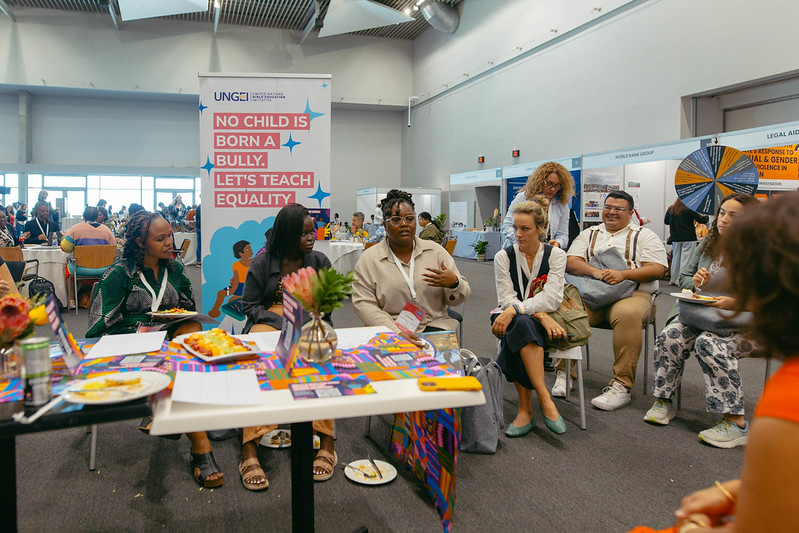
In a world teetering under the weight of rising fascism, silencing, surveillance. We laughed. We connected. We shared ideas not just as strategies, but as lifelines. We were reminded that resistance doesn’t always roar, sometimes it gathers quietly, around a table, in the shape of a question, a joke, a spark. This is the magic sauce: connection that restores, renews, and reminds us who we are when the world keeps asking us to forget.
There’s something wild and wonderful about what happens when you put that many people, all working to end violence, in one place. It’s not just the scale of it, it’s the frequency we all tune into. The emotional pitch. The feeling that, for once, you don’t have to explain why this work matters.
The message was unmistakable: the digital world is not neutral. It reflects the values of those who build it, and those who are left out of its design. We are either shaping it with intention, or being shaped by it without consent.”
Why the work on ending violence matters
You could feel it in the session on funding, where beneath the polite policy language was a raw truth: we are building lifelines on borrowed budgets. Women’s rights organisations, feminist collectives, survivor-led movements, we are asked to deliver miracles on twelve-month grants, with spreadsheets designed to measure output, not transformation. Those conversations didn’t just talk about underfunding, it pulsed with the quiet urgency of people trying to keep something sacred alive in a world that keeps asking them to shrink it. We shared so much. Our exhaustion. Our hacks for navigating inflexible donor demands. Our fury at short-termism dressed up as strategy. But we also shared something else, blueprints for a different way forward. Flexible funding models. Regional cohorts for mutual support. Radical honesty about what it takes to do this work well and survive it.
And in the tech sessions? We learned. Not just about harm, though it stretched wide: image-based abuse, doxing, deepfakes that turn women’s faces into weapons. The violence wasn’t abstract; it was algorithmic, intimate, relentless. But we also learned about resistance. About people building tools not to dominate, but to protect. Chatbots designed with tenderness. Platforms reclaimed as sanctuaries. In a world where technology so often amplifies harm, these interventions felt like acts of rebellion, small, luminous ways of saying: we still get to shape this world too. These weren’t sterile presentations. They were grounded, incisive, shaped by lived experience and political clarity. The message was unmistakable: the digital world is not neutral. It reflects the values of those who build it, and those who are left out of its design. We are either shaping it with intention, or being shaped by it without consent.
Then came the conversations on prevention and scale. What does it really mean to do this work well, not just once, but over and over, year after year, without losing its soul? We didn’t shy away from the tension. We acknowledged the danger of rushing to scale, of replicating without understanding, of losing what makes this work meaningful in pursuit of reach. But we also held the belief that scale doesn’t have to mean flattening. That growing doesn’t have to erase complexity. That relationality isn’t a luxury; it’s a method. And that care shows itself not only in intention, but in design, in ensuring what we build speaks to people’s lived realities, adapts to local contexts, and actually works where it’s needed most.

The SVRI Forum 2024: Catalysing connections in a world of disconnection
In those moments, connect – share – learn stopped being a tagline and became a living practice. It was felt in the pace of conversations that didn’t need to be rushed. In the way people leaned in to really listen. In the laughter that broke open after difficult sessions, not as distraction, but as a kind of release. Connection didn’t soften the science. It strengthened it. Because evidence without relationship is just information. And this work, our work, survives on our ability to return to each other. To restore. To remember why it matters.
What moved me most, though, more than any panel or presentation, was how the Forum asked us to take our bodies seriously. Not as tools for productivity. But as sources of knowledge. Sites of memory. Places where impact lives long after the research ends. The SVRI is at the forefront of this shift. Wellness wasn’t an afterthought. It wasn’t there to cushion the hard parts—it was part of the hard parts. The quiet spaces, the moments to breathe, to move, to simply be—these were not pauses from the work. They were the work. Because our bodies are not neutral. They are living archives. The past doesn’t sit politely behind us— it lives in our muscles, our sleep, our breath. And trauma doesn’t end when a project does. It lingers, moves differently in each of us, reshapes how we move through the world. To work on violence against women and girls is to move through the terrain of the body – our own and others’. So how could we not honour that? How could we not create space to stretch, to exhale, to say: this matters, and so do I.
The SVRI didn’t just host a conference. It created a holding space where knowledge was embodied, where care was structure, not sentiment. Where the work of building a world free from violence was grounded in the bodies of those doing it. And that’s what SVRI Forum 2024 was. Not just a gathering of experts, but a gathering of keepers—of knowledge, of stories, of strategies, of fatigue, of fire. Of those who refuse to forget, and those who are learning how to remember.
If you listened closely, you could hear the field speaking back to itself. The collective saying: we’re tired, yes, but we are not done. We are scaling prevention not as replication, but as transformation. We are building survivor-informed responses that honour complexity, not just compliance. We are pushing back against shrinking civic space, against anti-rights agendas, against the quiet normalisation of funding cuts dressed up as pragmatism. This work isn’t going away. And neither are we.
This blog was written by Joy Watson, Technical Specialist at SVRI. Joy has worked as a researcher and technical advisor in the field of violence against women for more than 20 years.
