


Intentional belonging: What all children with disabilities deserve
I am the lastborn of three children, and the only one with a disability in my family. I was born to parents who, like many parents in their position, did not know the first thing about raising a child with a disability. I was born and raised in a country that had limited access to resources and information to enable inclusion of children and adults with disabilities in social activities, institutions and various settings.
So, from a tender age, my parents made one thing clear: we were winging it, and we would have to trust each other as we learned together. I was taught to communicate my needs and not assume that my family would know them. They were honest about the gaps and trusted me as a partner in the journey. We improvised to ensure I was enabled to do my share of chores and my siblings saw I wasn’t slacking. I was an equal partner in our household. I felt part of a team – I felt like I BELONGED.
Some of my physiotherapy equipment was built by my dad, with me as the consultant, sole clinical trial participant, beneficiary and co-evaluator. He was the self-made designer, implementer and co-evaluator. He taught me the importance of the integrity of dovetail joints and carpentry material, and I told him what was working, what was not and why. We got creative with what we had, pivoted and adapted as needed. We tirelessly refined the improvisations until they worked. My dad and I learnt so much from each other, and our improvisations fit naturally because of it. We were curious, adventurous innovators. It was nothing but pure FUN!
Since I was young, I have only believed in one kind of inclusion: The intentional kind.
International Day of Persons with Disabilities: What counts as inclusion?
The 9th day of the 16 Days of Activism Against Gender-Based Violence – 3rd December – falls on the International Day of Persons with Disabilities. A stark reminder that women with disabilities, who are often excluded from violence prevention efforts, are indeed integral to the success of preventing violence against ALL women. Yet exclusion persists in many processes.
The involvement of women with disabilities in VAWG research and programming mainly occurs at a consulting level. But being invited in at the end to ‘check’ a tool or draft is not inclusion—it is quality control in an otherwise exclusionary process.
We need to think deeply and intentionally about inclusivity in our work if we are to achieve fitting programmes. Intentional inclusion means everyone having a genuine sense of belonging in a team, and this only occurs where equitable, meaningful, and mutually beneficial relationships are nurtured. We learn best from one another when we trust and value each other. Consultation is not enough. Shared power should be the goal.
The visibility – and invisibility – of disability
We also need to remember that disability is not always visible. Many women live with chronic pain, psychosocial disabilities, neurodivergence or sensory conditions that are not evident when they walk into a room or appear on a Zoom screen. If our sampling frames, eligibility criteria, tools, accessibility plans and safeguarding measures only imagine disability as a wheelchair icon, we will miss some voices, experiences and responses that shape our data and results.
Thinking about disability inclusion requires us to move beyond who we can see and to create designs that adapt to the full range of bodies, minds, and experiences, whether or not they are disclosed. This must be reflected in how we plan, budget, collect data, communicate, and deliver programmes and this can only be achieved if we are intentionally inclusive from the very beginning.
If our sampling frames, eligibility criteria, tools, accessibility plans and safeguarding measures only imagine disability as a wheelchair icon, we will miss some voices, experiences and responses that shape our data and results”.
Why intentional inclusion is not an option, but a necessity
Intentional inclusion enhances multi-directional capacity building in research and programming teams. This capacity building and knowledge exchange does not always happen in formal training settings behind desks or in front of laptops. They occur in informal settings as much as in formal training settings, and perhaps to a greater extent. Hence, healthy relationships that are grounded in trust are crucial. When we build authentic and healthy relationships in earnest, we effortlessly become intentionally inclusive. Consequently, capacity building and knowledge exchange emerge organically, and this strengthens research processes and outcomes.
Crucially, intentional inclusion demands an openness to learning from each other and a willingness to adapt based on what we hear. It asks us to slow down, to question whose expertise is centred, and to treat lived experience as equal to technical expertise. When women with disabilities are in the room as co-researchers, co-designers and co-leaders, they sharpen our questions, shift our priorities and help us see risk and possibility differently. This does not just ‘add a disability lens’; it transforms the quality, relevance and honesty of our outputs.
Valuing different perspectives is not a courtesy; it is a method for doing better work. Teams that hold space for disagreement, listen across hierarchies and disciplines, and respect the knowledge that comes from daily survival under oppressive systems produce stronger tools, safer programmes and better outcomes. In VAWG research and programming, this can be the difference between an intervention that looks good in a logical framework and one that women with disabilities can actually use, benefit from and shape over time.
Valuing different perspectives is not a courtesy; it is a method for doing better work…In VAWG research and programming, this can be the difference between an intervention that looks good in a logical framework and one that women with disabilities can actually use, benefit from and shape over time.”
Intentional inclusion also builds resilience. When our relationships, institutions and communities are structured around who fits the norm, they become fragile and exclusionary, especially in times of crisis. When they are built with and for those who are routinely left out, they are better able to adapt, respond and hold one another through shocks. Intentional inclusion of women with disabilities in VAWG work strengthens the networks of care, accountability and solidarity that make societies more cohesive in the fight against violence. In other words, intentional inclusion is not just ‘the right thing to do’; it is how we build more resilient teams, partnerships and societies.
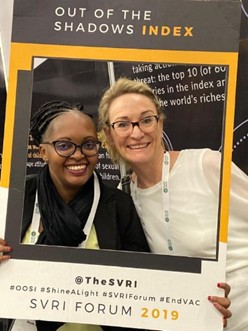
In the picture, Elizabeth Dartnall, SVRI Executive Director, and I (on the left) are having fun and learning at SVRI Forum 2019. The SVRI Forum is a space where we have continuously and intentionally learnt from one another, and each Forum has been stronger than the last. Our commitment to disability inclusion is part of that ongoing learning.
Here’s to continued learning at SVRI Forum 2026!
About the author
Dr Jane Ndungu is a psychologist, academic and advocate focusing on preventing violence against women and girls (VAWG), disability inclusion and mental health. Her work bridges research, policy and community practice, advancing feminist approaches to prevention and wellbeing. Through her transformational and inclusive work, she aims to make scientific evidence more accessible, equitable and impactful across academic and social contexts. She is currently a Wellcome Trust Research Fellow in the Department of Psychology at the University of Exeter, UK.
